 En
En
 Es
Es
This is the documentation for the deprecated product DCImanager 5. It is no longer updated and may be irrelevant. Documentation for the current version of DCImanager can be found in the DCImanager 6 section.
A server is the main physical item in the control panel. DCImanager allows to keep track of servers, monitor there statuses and connected equipment.
This article describes how to create a server. To do so, navigate to Main menu → Servers→ Add.
Server
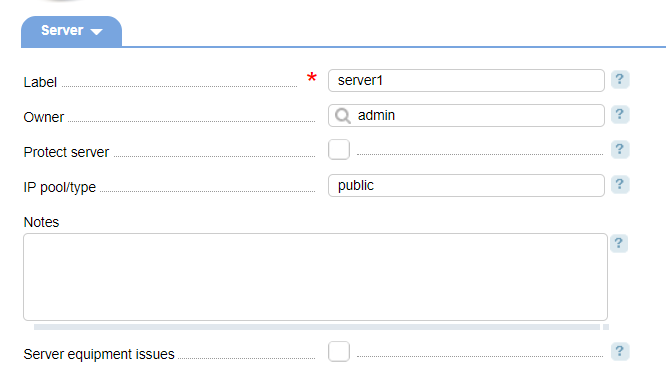
- Label- unique server name;
- Owner - select a user who will be the owner of the server;
- Protect server type - select the checkbox to forbid the operations with this server;
- IP pool/type — type/pool from which the IP address will be allocated to the server;
- Statistics collection— this field is displayed if you have installed the "NetFlow" module and enabled the policy "Use NetFlow/IPFIX to collect statistics" — "Only for the selected servers":
- according to the type — for more information please refer to Traffic usage statistics;
- Use NetFlow/IPFIX — for more information please refer to "NetFlow";
- Use switch.
- Notes - provide additional information about the server. It will be shown in the "Notes" column in the list of servers;
- Server equipment issues - select the checkbox to indicate that this server cannot be used.
Configuration
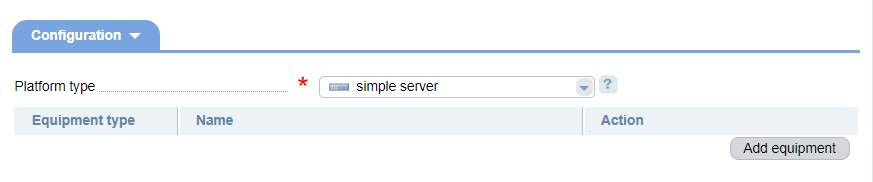
- Platform type — select a platform type. Add it in Equipment type → Platforms. For more information please refer to Platform types;
- Add equipment — click to add the spare part;
- Edit — click to edit the spare part;
- Plug out— click to delete the spare part.
System
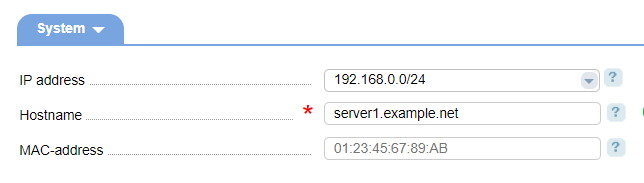
- Use the VPU network —select the checkbox to create a VPU-network for the server. The option is available if the "VPU (Vlan Per User)" module is installed. For more information please refer to the article "VPU (Vlan Per User)";
- IP address;
- Hostname - enter the domain name;
- MAC-address.
Location
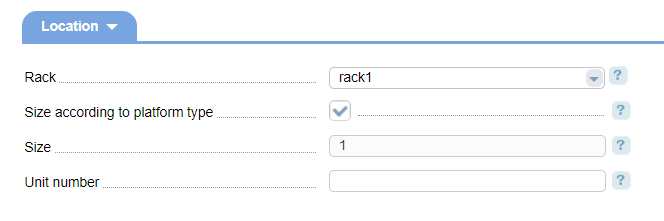
- Rack;
- Size according to the platform type — this option defines the server size in the platform;
- Size;
- Unit number — enter the rack unit number. For multi-unit equipment enter the upper position.
Purchase information
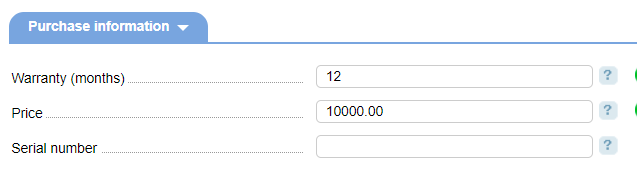
- Warranty in months;
- Price;
- Serial number.